
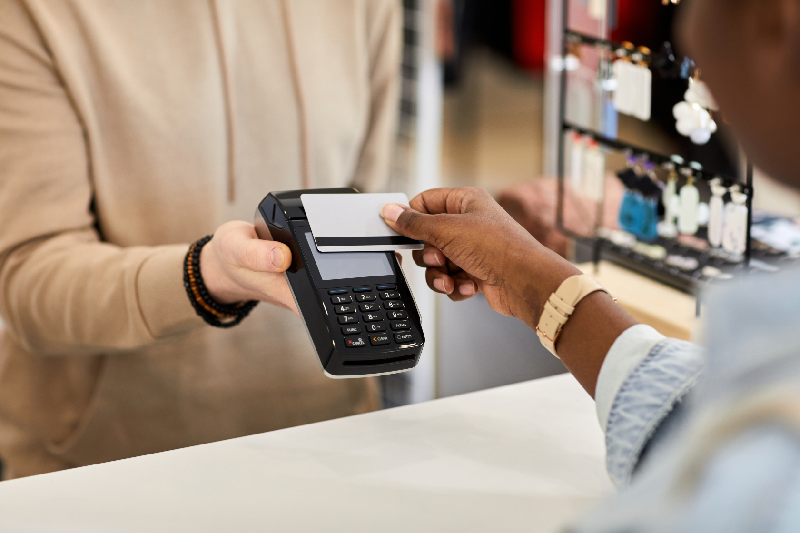

In today’s ever-evolving digital world, customers don’t always have cash on hand – and that’s assuming they’re even in a physical location where cash is an option.
No, times have moved on, and people pretty much expect to be able to purchase things online, or at the very least using their debit or credit card, if not contactless.
If you’re a business owner who has yet to make the switch to online payments, there’s simply no time to lose, and waiting any longer could result in you getting left behind.
But what exactly constitutes an online payment, and how do they work?
Also, what’s the cost involved?
Let’s take a look.
What are the benefits of online payment?
First and foremost, your business risks losing a sale if there’s no way for someone to pay via card, as they simply might not have cash on them (an increasingly common occurrence).
Like it or not, people have been conditioned to rely on online payment methods, and so carry less and less cash every year.
Being able to take card payments also means people will be inclined to spend more, as they’re not eating into any emergency cash reserves they do have.
Security is another big factor.
The reality is that businesses which deal in cash are more vulnerable to things like robbery attempts, putting staff at risk unnecessarily.
Conversely, when everything’s in the ether, it’s safe from physical threats.
Perhaps the biggest benefit, though, is simply convenience and accessibility, with online payments enabling customers to make purchases from anywhere in the world, and at any time.
This means businesses can receive payments instantaneously.
How do online payments work?
Online payment generally refers to when businesses accept electronic payments for goods or services purchased over the internet (or via card/contactless).
There are different types of online payments to be aware of as a business owner.
These include:
- Debit and credit card payments
- Bank transfers
- Digital wallets
Typically, payments go through a payment gateway and payment processor, and these authorise online payments by encrypting and transferring data securely.
Choosing the right online payment method
When it comes to choosing an online payment method, there are actually quite a lot to choose from, and some work better for different types of businesses.
It really comes down to what’s best for your business, based on your own unique needs.
With that in mind, the most common types include the following:
Credit and debit cards
These are undoubtedly the most common forms of online payment processing, mainly because of how easy they are to use.
To make an online purchase, customers simply enter their credit or debit card information into a payment gateway.
Or, if the sale is in person, they can use their pin or even just tap their card for smaller purchases (known as contactless).
Bank transfers
As the name would suggest, this method involves the transfer of funds directly from the customer’s bank account to the business’s bank account.
Bank transfers can be completed two main ways: either via online banking or with mobile banking apps.
Alternatively, they can be initiated and authorised through a retailer’s website or app.
Digital wallets
These offer a convenient alternative, allowing customers to store their payment details and make online payments quickly and easily.
Popular examples include PayPal, Apple Pay, and Google Wallet.
Direct debit
This is a recurring payment method where the customer gives permission for the business to withdraw a set amount from their bank account at regular intervals, much like a subscription.
Cryptocurrency
Crypto is a digital currency that can be used to make online payments in certain countries.
Although this is a newer option, it’s becoming more and more popular, and regulations around it are constantly evolving.
Setting up a payment system
For businesses, choosing the right online payment processing provider is key to being able to accept online payments.
There are some important factors to consider when looking for one, though.
For example, you’ll want to look for providers that offer advanced security features like fraud detection and prevention, as well as data encryption.
You’ll also want to consider the costs (transaction fees, setup fees, etc.) and also check how easily the payment processor can be integrated into your website or e-commerce platform.
Depending on the size of your business (and your plans for future expansion), you may also need a provider that supports multiple currencies and languages.
Popular online payment platforms and tools
Generally speaking, you’ll find that most online payment processors share similar features, and so your final choice is likely to be based on which you think best aligns with the unique needs of your business.
Whichever route you go down, the goal is the same – to make it as easy as possible for customers to hand over their money. Weigh up your transaction volumes, your customers’ preferred payment methods and how much control you want over fees and contracts, then pick the provider that suits you best. It won’t always be the one with the flashiest offer.
Get the basics right, and online payments stop being a technical hurdle and start being what they should be – one less reason for a customer to walk away.
Let’s compare some of the best payment processors for businesses in the UK to give you somewhere to start.
WorldPay
- Offers specialist payment packages for small and medium-sized businesses
- Supports a wide range of global payment methods
- A choice of countertop, portable, or mobile card machines
- Pricing split into two main tariffs (Simplicity and Custom), usually tied to an 18-month terminal hire agreement
Revolut Business
- Provides a wide range of payment processing solutions for small businesses, including in-person card readers, a free POS app compatible with iPhones, Macs, etc.
- Gives you the ability to accept online payments in up to 32 countries
- No hidden fees, and no set-up charges
- Fast access to money with 24-hour settlement, even on weekends
- To use Revolut Business’s payment solutions, you will need an account
- Prices start from £10 per month
Tide
- Banking and payment solutions for small businesses, including card readers, online payments, and Tap to Pay
- Standard and Plus card readers, both of which have Wi-Fi and lifetime free 4G connectivity
- Plus model allows you to print receipts
- You can rent or buy the device
- Alternatively, you can choose the pay-as-you-go model, with no monthly fees but an upfront cost of £159 and transaction fees from 1.39% + 5p
PayPal
- Offers a point-of-sale, card reader, invoicing, and an ecommerce platform
- Allows you to manage your inventory, send abandoned cart emails, and track your performance with real-time sales analytics
- Compatible with iOS and Android, accepting Samsung, Google, and Apple Pay
- 1.75% transaction fee
- Custom rates for businesses that take over £10,000 every month
Find more help in our online accounting hub, and learn more about how to find the right accountant for your business.
