

Whether cash still matters for your small business depends largely on who your customers are and how you operate. If you run a market stall, mobile service, or a business in an area with older or less digitally-connected customers, cash is likely still an important payment option worth keeping. If you’re predominantly online-based or your customers are almost exclusively paying digitally, it may matter a lot less.
Here’s a look at the role cash plays in today’s economy, and how to build a payment strategy that works for your business and your customers.
The ongoing demand for cash
It’s important to remember that not everyone knows how to use the latest technology.
Many older people, for example, still rely on cash to pay for their shopping, etc., and so a digital-only business is potentially cutting out a whole demographic.
There are also certain industries where cash is still widely used, mainly for convenience.
These include various hospitality and service businesses where tipping is a key part of the culture.
Benefits of accepting cash
In addition to being more inclusive and convenient, accepting cash means there are no processing fees to worry about, as these can add up over time.
It also helps maintain business continuity during payment outages, with cash being a vital backup when digital payment systems fail.
The UK’s Cashpoint landscape
So, cash still has a place.
But why is it becoming harder and harder to get hold of? And what can you do if your business is located in a more remote area with limited access to cash?
Recent trends
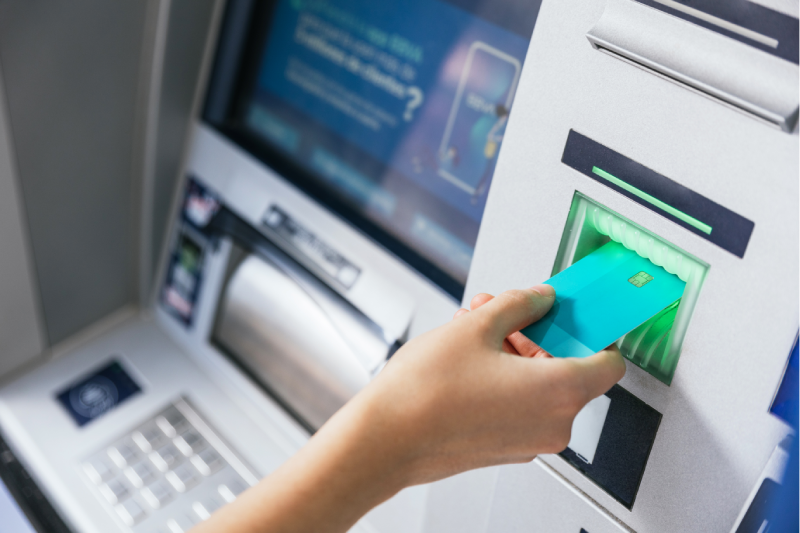
The growth of online banking and services like Apple Pay has resulted in ATM closures across the nation, as well as a reduction in the number of physical branch locations.
This shift towards digital payment methods means cash is scarcer than ever before.
How cashpoint proximity impacts SMEs
In terms of customer spending habits, having a cashpoint close to your business can support impulse purchases, as potential customers have the cash they need on hand.
There’s also usually more general footfall in the vicinity, which can help drive sales.
When it comes to daily operations, you’ll have to manage cash deposits and consider the security implications of transporting cash.
If your business happens to be located in a rural area, you’ll likely be forced to rely on local cash infrastructure (which we’ll get on to).
How to find your nearest cashpoint
Helpfully, there are many online services you can make use of if you’re struggling to locate the cashpoint/s in your area:
- Online ATM locators
- Banking apps
- Local authority and community resources
You should consider factors like the distance from your premises, operating hours, deposit functionality, and also accessibility/safety.
Alternatives to traditional cashpoints
For some business owners (for example, those in rural areas), there may not be many cashpoints left nearby – if any.
There are other options available, however.
Let’s take a look.
Cashback without purchase schemes
Many participating UK shops and supermarkets now support the LINK Cash at the Till network, allowing people to withdraw up to £50 in physical cash from their bank accounts, without having to purchase anything.
As well as giving better access to cash overall, this scheme specifically helps those with limited access to digital banking, and those who use cash to manage a budget.
What’s more, the LINK network keeps cash circulating locally.
Post Office banking services
Customers of a number of UK banks can actually do basic banking at a Post Office counter.
You can typically withdraw cash, pay into your bank account, and check your balance.
For a business owner, it works much like paying your shop takings into a bank branch, except the Post Office functions as a kind of intermediary, accepting the money on behalf of your bank.
The future of cash access for small businesses
New UK regulations enforced by the Financial Conduct Authority (FCA) require major banks to maintain reasonable local cash deposits and withdrawal services for small businesses.
In this sense, the government aims for people and businesses to have cash and services within 1 mile in urban areas and 3 miles in rural areas.
Still, business owners should take a pragmatic approach and come up with strategies to balance both cash and digital payments.
Strategies for SMEs
First and foremost, ensure you don’t get left behind by encouraging digital payments, while still retaining cash options for those who might need them.
When you come to choose an online payment method, consider which you think best aligns with the unique needs of your business.
Building a flexible payment strategy is key to long-term resilience, and so it’s important to regularly assess local cash access and explore alternative solutions where necessary.
This way, you’re supporting financial inclusion while still moving with the times.
Find more help in our online accounting hub, and learn more about how to find the right accountant for your business.
